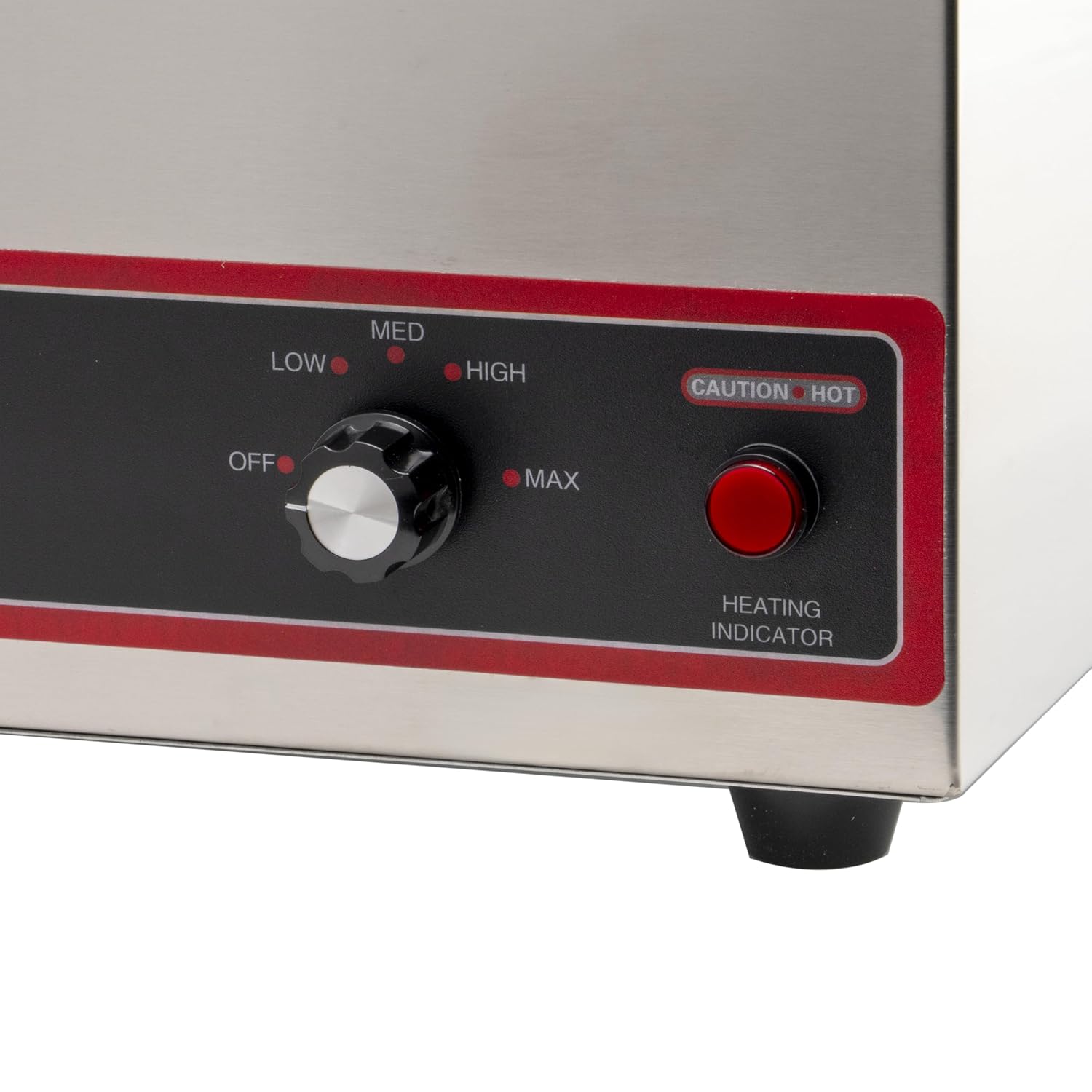
Maria ran a solid Cuban-food trailer for two years before her first county health re-inspection almost ended her. The inspector pointed at her full-size steam table — the kind you’d find in a hotel buffet line — and flagged three problems in under ten minutes: no visible NSF certification mark, an ambient interior temperature reading of 132°F instead of the required 140°F minimum, and an electrical draw that was overloading her 30-amp shore-power hookup. She wasn’t running substandard food. She was running the wrong equipment for the context.
A steam table is, at its simplest, a heated holding unit: a metal countertop with recessed wells filled with hot water (or dry heat elements) that keep cooked food at a safe serving temperature — typically 140°F or above, as required by the FDA Food Code — for hours at a time. In a mobile or catering environment, the choice of which kind of steam table you install determines your compliance posture, your power budget, your propane logistics, and in some states, your permitting category. This article walks through the three fuel paths (electric, propane, and combination), the regulatory baseline you can’t ignore, and a clear decision framework for choosing the right unit for your rig and service model.
| EDITOR'S PICK[VEVOR Commercial Food Warmer](https://www.amazon.com/dp/B0FM3QBCTX?tag=greenflower20-20) | Mid-tier[CAMMOO 127QT Non-Electrical Cat…](https://www.amazon.com/dp/B0DRVZXNMH?tag=greenflower20-20) | Budget pick[Winco FW-S500 Commercial Portab…](https://www.amazon.com/dp/B003FXGO7C?tag=greenflower20-20) | |
|---|---|---|---|
| Power type | Electric | Non-electric | Electric |
| Wattage | 1800W | — | 1200W |
| Pan count | 8 pans + 2 pots | 8 full-size pans (not included) | — |
| Material | Stainless steel | 304 stainless steel | Stainless steel |
| Mobility | Wheels | Casters | — |
| Price | $679.90 | $259.99 | $137.84 |
| See on Amazon → | See on Amazon → | See on Amazon → |
Why “Hot-Hold” Compliance Is Non-Negotiable Before You Pick a Unit
Before comparing BTUs and amp draws, you need to understand the regulatory floor you’re building on. Under FDA Food Code 2022, Chapter 3-501.16, hot potentially hazardous food (PHF) — meaning proteins, cooked starches, dairy-based items — must be held at 140°F (60°C) or above at all times after initial cook. Drop below that threshold and you’re in the temperature danger zone (41°F–139°F), where bacterial growth accelerates rapidly.
Most state and county health departments have adopted the FDA Food Code in full or with minor modifications. A small number of jurisdictions — notably California, which operates under its own Retail Food Code — maintain the same 140°F standard for hot-hold but add supplemental rules around equipment certification. Across the board, NSF International’s Standard 4 certification is the minimum equipment marker inspectors look for. Per NSF Standard 4’s published scope, certified units are tested for their ability to raise and maintain food-contact surface temperatures under defined load conditions. If your steam table doesn’t carry the NSF 4 mark (or an equivalent ANSI/NSF certification), you’re at risk in virtually every jurisdiction.
One more variable that surprises operators: recovery time. Your steam table needs to reach and hold 140°F, not just hit it momentarily. Units with undersized heating elements — common in residential or “foodservice-adjacent” units marketed on general retail sites — can struggle to recover after a full cold-pan load-in. QSR Magazine’s coverage of mobile hot-hold failures consistently identifies undersized wattage as the primary cause of inspection violations that weren’t obvious at purchase.
Electric Steam Tables: The Shore-Power Trade-Off
Electric steam tables are the default choice for operators with reliable 120V or 240V shore-power access — think festival slots with provided hookups, corporate campus parking, or commissary staging. They’re cleaner to operate (no fuel line, no open flame risk), easier to get permitted in fire-restricted venues, and generally more affordable at the entry tier.
The math that matters here:
| Unit Size | Typical Wattage | Amps at 120V | Amps at 240V |
|---|---|---|---|
| 2-well countertop | 1,000–1,500 W | 8–13 A | 4–7 A |
| 4-well drop-in | 2,000–2,800 W | 17–23 A | 9–12 A |
| 5-well full-size | 3,000–4,000 W | 25–33 A | 13–17 A |
If you’re on a 30-amp, 120V hookup — the most common shore-power offering at events and commissary lots — a 5-well electric table will consume most of your available amperage before you’ve turned on a single other appliance. Operators running electric tables at scale almost universally run 240V service or size down to a 2- or 3-well unit. Food Truck Empire’s equipment checklist strongly recommends calculating total amperage load before specifying any electric hot-hold equipment.
On the generator side, electric steam tables are generally not recommended as generator-primary loads. A quality 6,500-watt generator running a 4-well electric table still has overhead for lighting and a POS system, but throw in a prep refrigerator and you’re at the edge. Generator duty cycles also affect the table’s heating consistency — voltage sag under load can push a borderline unit below 140°F intermittently, which is exactly the kind of failure that doesn’t show up until an inspector arrives with a calibrated thermometer.
Where electric wins decisively: indoor venues, fire-suppression-required events, brewery lots, university dining deployments, and any location where open flame or propane is explicitly prohibited. It also wins on total cost of ownership when shore power is cheap or included in your pitch fee.
Propane Steam Tables: Off-Grid Performance With Real Trade-Offs
Propane-fired steam tables are the go-to for operators who work remote events, outdoor festivals without power hookups, or large-footprint catering rigs where running 240V to every station isn’t practical. A well-spec’d propane unit can hit and hold 140°F faster than most electric equivalents and maintain that temperature regardless of what else is running on your electrical panel.
The trade-offs are real and worth naming directly.
Permitting friction. Many indoor venues — convention centers, university facilities, corporate campuses — prohibit open-flame cooking and holding equipment entirely. Some states require a separate LP gas system inspection as part of the mobile food unit permitting process. Restaurant Business Online’s analysis of mobile kitchen regulatory trends notes that propane equipment inspections have become more rigorous in densely populated metro markets since 2023, with some counties now requiring shutoff valve placement specifications as part of plan review.
BTU sizing. Propane steam tables are rated in BTUs per burner. A typical 2-burner countertop unit runs 10,000–20,000 BTU total; a 4-well full-size unit may run 40,000–60,000 BTU. Higher BTU ratings mean faster recovery, but they also mean higher propane consumption per service. For a 6-hour outdoor event, operators running 40,000-BTU tables should budget roughly 1–1.5 lbs of propane per hour under moderate load — plan your tank sizing accordingly.
Ventilation requirements. Even in an open trailer or outdoor setup, your local fire marshal may require documentation of adequate ventilation clearance around propane holding equipment. This is worth confirming before your next permit renewal, particularly if you’ve added equipment since your original inspection.
Where propane wins: remote events with no shore power, large outdoor festivals, barbecue and smoked-meat concepts that already have propane infrastructure on the rig, and operators who want independence from event power quality.
Combination and Dry Heat: When Neither Fuel Type Is Clean
A growing category worth understanding is the dual-fuel or electric-dry-heat hybrid. Some fabricators — Prestige Food Trucks and Cruising Kitchens have both offered these configurations in custom builds — wire a unit to run off shore power when available and switch to propane when not. This adds upfront cost (expect a $400–$900 premium over a single-fuel unit at the commercial tier) but gives an operator genuine flexibility across venue types.
Dry-heat holding units (no water bath, direct element heat) deserve a mention here because they’re frequently confused with steam tables in spec conversations. Dry heat units hold food at temperature through radiant or conductive heat without a water pan. They’re simpler to clean, lighter, and often preferred for fried or breaded items where steam would compromise texture. The compliance standard is identical — 140°F minimum — but the holding mechanics differ. If your menu includes fried chicken, egg rolls, or anything with a crisp exterior, a dry-heat unit or a combination well (some units allow you to run a well dry or wet) may serve you better than a traditional steam table.
The Decision Framework: If X, Then Y
By this point you have a current spec decision in front of you. Here’s how to resolve it cleanly.
If you work primarily indoor or venue-controlled events: Go electric. Choose a unit sized to run on 240V if possible, or budget carefully against your 30-amp shore-power capacity. Confirm NSF 4 certification before purchase. Units from Vollrath, Hatco, and Nemco in the $800–$2,500 range consistently appear in operator reviews as reliable performers for 2- to 4-well configurations at this tier.
If you work outdoor festivals or remote events without reliable power: Go propane. Size your BTUs to your menu load, not your trailer footprint. Budget your tank supply per event, and verify your jurisdiction’s LP inspection requirements before your next permit cycle. Units from Winco and Admiral Craft in the $600–$1,800 range are frequently cited by operators in long-run reviews for durability in outdoor service environments.
If you’re doing a full turnkey build with a fabricator: Have an explicit conversation about dual-fuel capability before the build spec is finalized. The incremental cost is modest relative to total build price, and the venue flexibility has real revenue implications — one more event slot you can say yes to pays for the upgrade quickly. Ask your fabricator for documentation that the propane installation meets your state’s mobile food unit LP system requirements; this is a detail that can delay your Certificate of Occupancy if it’s not resolved in plan review.
If your menu requires texture-preserving hold (fried items, breaded proteins): Evaluate dry-heat or combination wells before defaulting to a water-bath steam table. The regulatory standard is the same; the food quality outcome is different.
Regardless of fuel type: before any unit goes into service, document your pre-service temperature log procedure. FDA Food Code compliance isn’t just about having the right equipment — it’s about demonstrating that the equipment is working. A simple temperature log at open, mid-service, and close is the difference between an inspector who signs off quickly and one who pulls your permit pending re-inspection.
Maria ended up replacing her hotel-grade unit with a 3-well NSF-certified electric countertop table spec’d for 240V and running off a dedicated 20-amp circuit her fabricator added during a rig refresh. Her re-inspection took eleven minutes and she passed on the first check. The equipment cost her $1,100. The permit reinstatement she avoided would have cost three weeks of revenue. That math is always the right place to start.